Brand Identity

Which color manifests your brand identity?

8 Mins

When you think of Nickelodeon, orange comes to mind; when you think of Coca-Cola, you imagine red; when you think of Facebook, you think dark blue. In the eyes of the target market, color repetition is part of the brand; it communicates the company’s values and visually differentiates it from competitors.


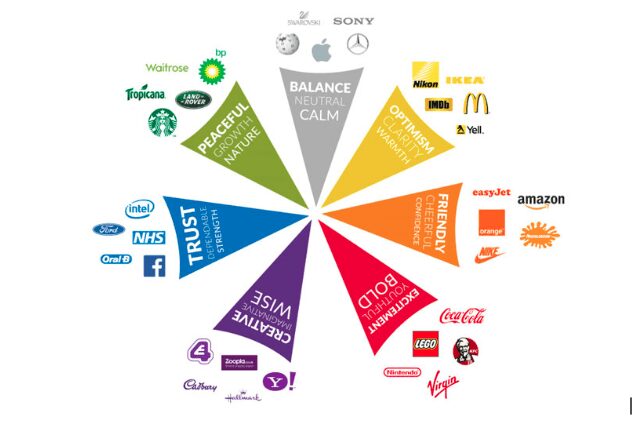
Different colors carry different meanings and trigger different emotions, such as the ones in the chart below. Before deciding your own brand’s colors, spend some time reviewing your competitors’ brand identities to ensure that yours stands out, and that the colors reflect your business’ personality and tone of voice.
 

A brand’s palate should include three colors:

  1. a base
  2. an accent,
  3. and a neutral color.

Your base color is the foundation of your color palate; it should reflect your brand’s most dominant personality trait. Your accent will be used almost as often as your base color. It should not only match the base color, but also be in line with your brand’s characteristics. Lastly, a neutral color that can be used as a background. Most often this color is not overpowering or attention-grabbing.


Keeping the above in mind, there are several options when it comes to creating a color scheme:


  • Monochromatic: A monochromatic color scheme consists of different shades of the same color. For brands with one trait that dominates over all the others, monochromatic schemes offer a great solution.
  • Analogous: Analogous colors are next to each other on the color wheel (e.g. red and orange), and usually have similar emotional connotations, but not as strongly as a monochromatic palate. Analogous color schemes are safe, but do not stand out as much.
  • Complementary: Colors that are directly opposite each other on the color wheel are known as complementary colors. These colors, when paired, bring out the best in each other (e.g. yellow and purple). The stimulating and dynamic nature of complementary color palettes makes them very popular, so be mindful that your color scheme does not match another brand too closely.
  • Triadic: Triadic colors are evenly spaced out on the color wheel (e.g. orange, purple, and green). These pallets are safe, stable, and offer variety, but need to accurately reflect your brand identity.


Research demonstrates that consumers perceive the same characteristics in brands as they do in people; consumers rely on emotional associates and instinct to choose your brand over others. An effective, consistent visual identity will foster loyalty, beyond just a one-time decision. These colors should be present across all consumer touch-points: your website, your logo, social media, product packaging, etc.


Putting together a visual brand can be intimidating. We’d love to help.

Aizaz Ul Hassan

Sr. Graphic Designer & Web Developer

Aizaz has been the driving force behind Silesky’s web development for over 5 years. As both a graphic designer and UI/UX developer, he brings a rare mix of technical precision and creative clarity to every project. What sets Aizaz apart is his ability to understand and interpret the assignment—no extra hand-holding, just sharp instincts and calm professionalism. When timelines are tight and expectations are high, Aizaz is the teammate you want in your corner.

Creative and detail-oriented, Aizaz builds clean, modern websites that marry style with substance. From intuitive flows to scalable layouts, his work consistently delivers digital experiences that perform as well as they look. With every project, Aizaz ensures the design feels effortless for users and does the heavy lifting for the brand.

Off the clock: It's an ongoing mystery.

John Sindorf

Director of Strategic Alliances

John believes most businesses don’t need more vendors, they need the right strategic partners.

With decades of experience helping small and mid-sized organizations grow, John specializes in connecting business leaders with the expertise they need to overcome challenges, strengthen operations, and scale with confidence. Whether the conversation centers on sales strategy, marketing, AI, or operational efficiency, his focus is always the same: identifying the right solution for the business, not simply adding another service provider.

Known for his relationship-first approach, John builds partnerships rooted in trust, practical guidance, and measurable outcomes. He helps business owners simplify complex decisions, align the right resources, and spend less time managing vendors and more time leading the businesses they’ve worked so hard to build

Off the clock: You’ll likely find John networking over coffee, strengthening relationships, and proving that the best business opportunities still begin with genuine conversations.

Kiki DeVane

Marketing Operations Manager

From Capitol Hill to the Content Calendar. The Filibuster Didn't Make the Cut.

Kiki started her career trying to change the world through legislation. She pivoted to marketing after realizing a well-built website could do it faster. What followed was a stretch across event marketing, federal communications, and sponsored content for some of the world's most recognizable brands, enough range to make her what the industry calls a utility player, which mostly means she can do the thing no one else wants to do and make it look intentional.

At Silesky Marketing, her job is to make sure the right work gets to the right person at the right time. When something tries to fall through the cracks, she's already caught it.

Off the clock: Somewhere between a passport stamp and a paintbrush.

Meital Abraham

Market Expansion & Social Media Strategist

Compulsive Jazz Hands

Meital studied fine art, advertising, and philosophy before adding stand-up comedy to the mix, which is either a very strange combination or the exact right training for social media strategy. Comedy teaches you to read a room, adapt to shifting audience energy, and deliver a punchline precisely when it matters. Misread a crowd on stage, and you get silence. Misread it in an algorithm, and it shows in the metrics. Her first corporate accounts were a cemetery, a law firm, and an IT company. She figured them all out.

Off the clock: Currently finding new ways to bedazzle herself and dazzle the audience.

Mya Stengel

Content Developer

Organizing Her Bookshelf = Organizing Her Life

Mya spent years working on her written prose only to pivot into writing for film in Hollywood. She went as far as to work in the film development department at Blumhouse before transitioning to content marketing. What she brought from the development room is the Hollywood standard. Never negotiate. Every draft has a skeleton before it gets a voice. To Mya, every client is a new protagonist to study. Her job is to entirely disappear into a brand's architecture, making the final copy sound authentically like them.

Off the clock: She's in the movie theatre, patiently waiting for Nicole Kidman to remind her that heartbreak feels good in a place like this.

Ashelin Walker

Digital Growth Strategist

The Human Embodiment of a Zen Garden

Before Ashelin was in Google Analytics, she was managing a fast-paced cafe. When the POS system crashed 20 minutes before doors opened, she rebooted it, rerouted the payment terminal, and had the register running before the first customer arrived. That same instinct drives every digital campaign she manages at Silesky Marketing today. She tracks algorithmic shifts, adjusts budgets in real time, and ensures clients see the concrete numbers behind every strategic decision.

Off the clock: She’s likely baking… What? it is a mystery she refuses to solve for us.

Susi Silesky

Founder & Brand Architect

Thinks in two languages. Solves problems in one.

Susi has spent more than 30 years helping clients see what's possible, and clearing the path to get there. She founded Silesky Marketing in 1996 after her early career in Paris, where she worked as the American liaison at S3C Groupe de Communication Souham, working on large-scale marketing campaigns for Sara Lee, Gillette, and Tiffany and Co.

Helping American brands navigate language and cultural differences taught her something that's shaped every engagement since: businesses often struggle to see themselves the way customers do. When she's not in client strategy, she's watching French films, which after thirty years of brand voice reviews pulls her out of English completely.

Off the clock: Scouting for strangers…or as she calls them, her new best friends.