

New Year, New Resolutions for Growth

With each new year comes opportunities for businesses to become better than ever. When the new year approaches, it is good to start thinking of new business resolutions for growth. Here are our top three New Year, new resolutions for growth in 2023.   Expand Social Media Channels New Year. New Resolution for Business means time to make some changes. Devoting time to social media and other digital channels is very important for small businesses. More and more people are using social media which is a top business trend that is expected to grow in 2023. There are many platforms that businesses can use to reach a wide variety of consumers by advertising and engaging directly with the customers using different marketing techniques.  This helps build customer loyalty as well as helps the business build their image and brand.   Learn a New Business Skill The world of business is full of learning opportunity. Learning new software, apps, or other business-related information can not only help your business thrive but can help you grow as a business owner. Your business will not take off if it stays in a bubble. Keeping up with the new trends is the perfect way to learn something new. Being able to adapt to new things is always a win when it comes to your business.   Stay Consistent Consistency is the key to success. Whether it is posting daily, writing weekly blogs, or making videos, it is important to be consistent so the business attracts more followers as well as increases traffic to the site.  This reflects on your business and staying consistent will give the image that your business is true to their customers and care about their content. It is fact that consistently leads to results, especially in business.   New Year’s resolutions can be a very helpful tool when it comes to your business. Creating new business resolutions for growth is the perfect way to start the new year.
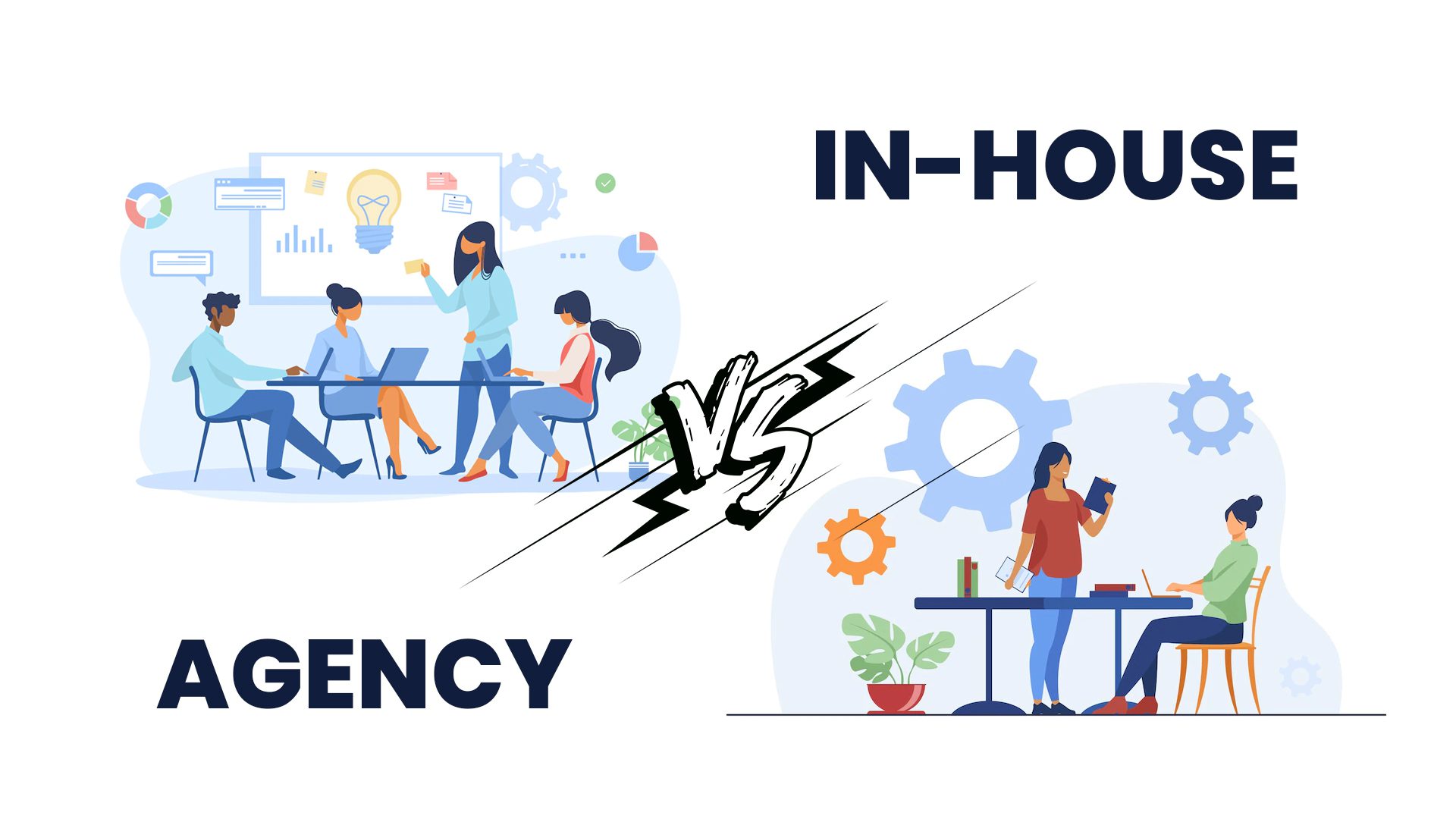

In-house Agency vs Outsourced Agency

So, you want to market your business. The first step is to decide whether you want to create an in-house marketing team vs working with an agency. Each of these solutions has pros and cons; what works best for one company might not for another.   Marketing Agency PROS vs CONS Expertise – You are now working with experts who have a wide berth of knowledge and are not limited one-dimensionally. Some agencies may specialize in specific industries. However, all agencies understand how to make the best use of your budget, build your brand voice and message, and track analytics. Agencies can also show you a return on your investment. Capabilities, software, and tools – As marketing professionals, agencies have all the right tools and software to build your brand effectively. There is no need to purchase your own software or invest in a bank of information.  Agencies have more training and experience, and can focus on helping you reach your goals and objectives. Specialties – Agencies are composed of people with different degrees of specialization who work together to create multiple cross-channel campaigns, whereas an in-house team might be limited in this area. Scalability – At busy times of the year, some in-house agencies may not have the bandwidth to sustain or increase your marketing presence. Multiple clients – While agencies are committed to each brand they work with, some clients could feel put off by the notion that the agency is working just as hard with other clients. However, this is often not the case. Your account managers are a part of your team and want to see you succeed. Control – Sometimes it is hard for businesses to relinquish any control over their marketing efforts, but agencies function best with some wiggle room. They value your input, and will not move forward with any big strategy decisions unless you grant your permission first. The ability to trust your agency to pursue your best interest doesn’t always happen overnight.   In-House Marketing Team PROS vs CONS Brand familiarity: – The people who work within your company know the brand — presumably inside and out. They have a thorough understanding of what you do, why you do it, and what goes into it on a daily basis. While agencies are committed to getting to know the ins and outs of your brand, in-house teams have a different stake in the game. Accessibility – Everyone works for the same company. Focus – Your in-house team does nothing but marketing for you and cash their paycheck. Recruiting Talent – Putting together a solid in-house team that works well together is a massive time and financial investment. Expenses – A successful marketing team uses SEO tools. In fact, this is another reason why an agency is a better idea. SEO training requires consistent CEU clases to keep up with industry trends. In-house marketing departments typically freelancers if your employees aren’t trained in everything you need to accomplish your goals. You can usually count on an agency to have the necessary tools already at their disposal, so you don’t have to fund them independently. Capability and Scalability – When putting together your team, you are limited to the skills found within your applicant pool and the resources you have to work with. Assembling your dream marketing team can be a long and costly process. In-house teams often have less access to specialized skill sets. Similarly, any employee turnover can offset the balance of your team and lead to setbacks. This puts pressure on the remaining staff, which could lead to lagging performance. Compare this to an agency, where there is no risk of your strategy being put on hold.   At Silesky, we pride ourselves on being an outside agency with an in-house attitude. Want to learn more about what that means? Give us a call.

When you Fail to Plan, you Plan to Fail.

Good marketing doesn’t happen overnight. As the saying goes, when you fail to plan, you plan to fail. Good marketing is a process that follows a well-thought-out plan to achieve specific marketing goals. Backed by research, a marketing plan can help you increase revenue and profits, rise above competitors, gain greater visibility, and more. While this does sound a bit daunting, it’s always best to start by analyzing your current situation.   Where Are You? Start by asking yourself and your team members a few basic questions. For example: what does our company exist to do? Reflect on the company’s mission statement as well as past successes, past failures, situations you have learned from, etc. Then, dive into your realistic goals and next steps by conducting a SWOT analysis to review the company’s current strengths, weaknesses, opportunities, and threats. Competition Once you’ve answered these questions, it’s time to compare the results with your competitors’. How have other companies in your same market navigated similar issues? How have they modified their approaches when faced with threats? Moreover, think about why and how customers use your product or service. What problems does your product or service solve? If it doesn’t stand out, it’s time to assess the things you can do to differentiate yourself from your competition. Burger King and McDonald’s both sell burgers. Nike and Adidas both sell sneakers. Avis and Hertz both rent cars. What’s the difference in their brand? What makes you choose one over the other. Thinking about what makes your business different is essential to its longterm success.   Target Audience As a business, understanding your target audience is vital. Start by designing your customer personas. Typically, every business has more than one target audience. To hone in on your top tier target audience think about a typical day in the life of your best customer. Do they live close by? Is distance even relevant? What is their purchase intention? Do they typically need your product or service right away, or during a specific time of year? What is the common thread; are they the CEO who makes the decision to purchase, or in a support role? Do they fall inside a specific age group? Ethnic Group? Religious Group? Google Analytics offers extensive data about who is visiting your website. You can find age, gender, location, income, education level, profession, marital status and more to help set your ideal target audience. Set Measurable Goals Regardless of what you want to achieve, it is essential to set goals to assess your progress. Developing a “SMART” plan encourages you to create goals that are specific, measurable, attainable, relevant, and  time-bound. This approach helps you stay on track, identify and correct shortcomings, visualize your goals, and allocate time and resources wisely. Budget If you know you will have a limited budget, sometimes it is best to determine the budget through the previous four steps. It’s important to remember that your strategic marketing plan is an investment in both the short and long term success of your business. So, spend wisely but maintain an annual marketing budget so you can track what has worked year in and year out. Strategy Mix The strategy mix consists of the Four P’s of Marketing: product, price, promotion, and place. Each P has its own tool. For example, Price can be discounts, payment period, credit terms. Place can mean where your clients can buy from you; your physical locations versus online, or in other stores. An effective marketing strategy combines the 4 Ps in order to  establish the product or services’ position within the market.   Don’t rush through this process. It’s a big deal and when done correctly, it reaps great rewards! What are you doing to ensure that your marketing efforts are delivering the results you’re looking for? Let us know at creative@sileskymarketing.com.

How to Keep Your Brand Consistent Across Every Marketing Channel

Keys to cross channel branding include consistent and recognizable branding so viewers remember your business. So, how do we accomplish that? Let’s review a few steps to maintain brand consistency across marketing channels: KNOW YOUR AUDIENCE Before you begin piecing together your brand strategy, you must understand whom you are trying to reach. Creating buyer personas is a great way to stitch together an idea of who you are selling to, what problem they are looking to solve, what they like and dislike, how they spend time online, etc. In addition, factors like tone, style, and frequency can affect how potential customers respond to your brand. CHOOSE YOUR VOICE Once you’ve thoroughly analyzed your target audience and what they respond best to, you can determine the brand voice. A brand voice can be humorous or serious, casual or professional, instructional or emotional. What would your brand’s personality be if it were personified? Think about which key elements of your business you would want to be immediately understood by your audience. CREATE A BRAND GUIDE Members of your target audience should be able to identify your marketing within only a few seconds of seeing it. Ideally, your audience should be able to tell it’s your brand without the logo. To accomplish this, you need to have a brand guide, which is a mapped-out set of rules and standards for visual and written material. A proper brand guide includes a specific color palate, tone and voice, font, copy, images, and more. It is also vital that these features stand out from the competition. Keeping brand uniformity increases brand recognition in any marketing channel, even if they require different approaches.   BALANCE FREQUENCY Striking the balance between under- and over-communicating is tricky; it’s essential to stay relevant in the minds of potential customers without overwhelming them. Creating a marketing calendar allows the brand to remain active without spamming followers. Maintaining frequency and consistency helps your audience know what to expect from you and want to hear more about your offer.   BE HUMAN Marketing is all about personality. Your audience should never feel like they are interacting with a faceless bot, but rather a human who cares about and can relate to their needs. People who feel seen and heard are more likely to trust the brand. Moreover, providing a personal response to any question or customer service issue is a great way to reinforce your brand and its dedication to its customers. Brand consistency throughout all marketing channels is vital to the brand’s success. At the end of the day, a poorly managed brand is sometimes worse than no brand at all. At Silesky Marketing, we would love the opportunity to help create a brand and strategy conducive to this approach. Schedule a meeting with our team to learn more about our background and how we can help your brand grow.

Aizaz Ul Hassan

Sr. Graphic Designer & Web Developer

Aizaz has been the driving force behind Silesky’s web development for over 5 years. As both a graphic designer and UI/UX developer, he brings a rare mix of technical precision and creative clarity to every project. What sets Aizaz apart is his ability to understand and interpret the assignment—no extra hand-holding, just sharp instincts and calm professionalism. When timelines are tight and expectations are high, Aizaz is the teammate you want in your corner.

Creative and detail-oriented, Aizaz builds clean, modern websites that marry style with substance. From intuitive flows to scalable layouts, his work consistently delivers digital experiences that perform as well as they look. With every project, Aizaz ensures the design feels effortless for users and does the heavy lifting for the brand.

Off the clock: It's an ongoing mystery.

John Sindorf

Director of Strategic Alliances

John believes most businesses don’t need more vendors, they need the right strategic partners.

With decades of experience helping small and mid-sized organizations grow, John specializes in connecting business leaders with the expertise they need to overcome challenges, strengthen operations, and scale with confidence. Whether the conversation centers on sales strategy, marketing, AI, or operational efficiency, his focus is always the same: identifying the right solution for the business, not simply adding another service provider.

Known for his relationship-first approach, John builds partnerships rooted in trust, practical guidance, and measurable outcomes. He helps business owners simplify complex decisions, align the right resources, and spend less time managing vendors and more time leading the businesses they’ve worked so hard to build

Off the clock: You’ll likely find John networking over coffee, strengthening relationships, and proving that the best business opportunities still begin with genuine conversations.

Kiki DeVane

Marketing Operations Manager

From Capitol Hill to the Content Calendar. The Filibuster Didn't Make the Cut.

Kiki started her career trying to change the world through legislation. She pivoted to marketing after realizing a well-built website could do it faster. What followed was a stretch across event marketing, federal communications, and sponsored content for some of the world's most recognizable brands, enough range to make her what the industry calls a utility player, which mostly means she can do the thing no one else wants to do and make it look intentional.

At Silesky Marketing, her job is to make sure the right work gets to the right person at the right time. When something tries to fall through the cracks, she's already caught it.

Off the clock: Somewhere between a passport stamp and a paintbrush.

Meital Abraham

Market Expansion & Social Media Strategist

Compulsive Jazz Hands

Meital studied fine art, advertising, and philosophy before adding stand-up comedy to the mix, which is either a very strange combination or the exact right training for social media strategy. Comedy teaches you to read a room, adapt to shifting audience energy, and deliver a punchline precisely when it matters. Misread a crowd on stage, and you get silence. Misread it in an algorithm, and it shows in the metrics. Her first corporate accounts were a cemetery, a law firm, and an IT company. She figured them all out.

Off the clock: Currently finding new ways to bedazzle herself and dazzle the audience.

Mya Stengel

Content Developer

Organizing Her Bookshelf = Organizing Her Life

Mya spent years working on her written prose only to pivot into writing for film in Hollywood. She went as far as to work in the film development department at Blumhouse before transitioning to content marketing. What she brought from the development room is the Hollywood standard. Never negotiate. Every draft has a skeleton before it gets a voice. To Mya, every client is a new protagonist to study. Her job is to entirely disappear into a brand's architecture, making the final copy sound authentically like them.

Off the clock: She's in the movie theatre, patiently waiting for Nicole Kidman to remind her that heartbreak feels good in a place like this.

Ashelin Walker

Digital Growth Strategist

The Human Embodiment of a Zen Garden

Before Ashelin was in Google Analytics, she was managing a fast-paced cafe. When the POS system crashed 20 minutes before doors opened, she rebooted it, rerouted the payment terminal, and had the register running before the first customer arrived. That same instinct drives every digital campaign she manages at Silesky Marketing today. She tracks algorithmic shifts, adjusts budgets in real time, and ensures clients see the concrete numbers behind every strategic decision.

Off the clock: She’s likely baking… What? it is a mystery she refuses to solve for us.

Susi Silesky

Founder & Brand Architect

Thinks in two languages. Solves problems in one.

Susi has spent more than 30 years helping clients see what's possible, and clearing the path to get there. She founded Silesky Marketing in 1996 after her early career in Paris, where she worked as the American liaison at S3C Groupe de Communication Souham, working on large-scale marketing campaigns for Sara Lee, Gillette, and Tiffany and Co.

Helping American brands navigate language and cultural differences taught her something that's shaped every engagement since: businesses often struggle to see themselves the way customers do. When she's not in client strategy, she's watching French films, which after thirty years of brand voice reviews pulls her out of English completely.

Off the clock: Scouting for strangers…or as she calls them, her new best friends.