
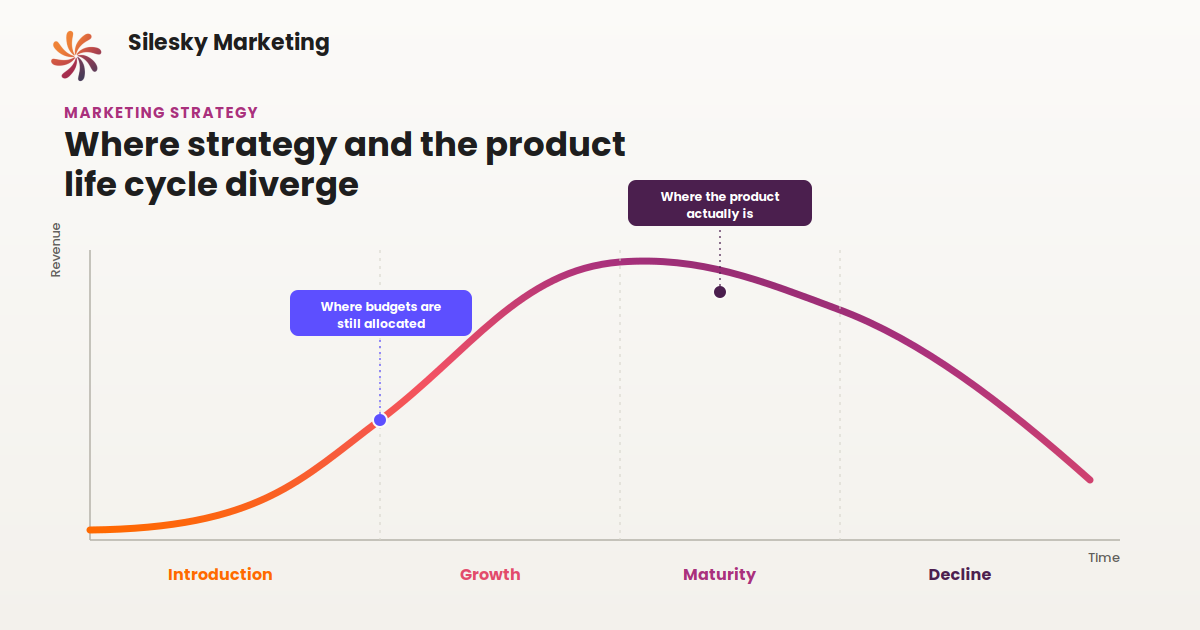
Where Your Marketing Strategy and Product Life Cycle Diverge
Most marketing budgets are still built for a business that grew up years ago. The product changed, the audience changed, and the spending never caught up. That mismatch tracks closely with where a product sits in its life cycle. Businesses spending like they’re still in an earlier stage usually don’t realize they’ve moved past it. Most Marketing Budgets Are Fighting the Wrong Stage The imbalance starts with where dollars get allocated across the four stages. Acquisition Spending Keeps Outpacing Retention, Even Where Retention Wins National data backs this up. The CMO Survey is a joint research effort from Duke’s Fuqua School of Business, Deloitte, and the American Marketing Association. It found that acquisition budgets run 26% larger than retention budgets across industries. That gap holds even though retention consistently delivers a stronger return than acquisition. It means most companies are overspending on the harder, more expensive job while underspending on the one already working. Campaigns without a strategy holding the plan together tend to get built tactic by tactic. Each new addition gets bolted onto whatever worked last quarter instead of the stage the business is in now. Why This Mismatch Keeps Happening The idea that marketing strategy should track a product’s life cycle isn’t new. Theodore Levitt made the case in the Harvard Business Review nearly sixty years ago. He argued that businesses which mapped their strategy to a product’s real stage would outperform competitors. Those competitors were often still running plans built for an earlier one. His finding held up over decades. Most executives can describe the four stages accurately, but almost none apply the framework inside their own budgets. Knowing the concept turns out to be a different skill than building a budget around it. The Four Stages of the Product Life Cycle Before any of that spending can get realigned, the four stages need a shared vocabulary. Introduction and Growth Introduction and Growth are two distinct phases, even though they often get treated as one continuous ramp-up. Introduction: the product is new to the market, awareness is low, and revenue is thin against a heavy marketing spend. Growth: demand accelerates, competitors start noticing, and the priority shifts from creating awareness to capturing market share quickly. The jump between these two stages usually happens faster than the marketing plan adjusts for it. A company still spending like it’s in Introduction keeps pouring budget into brand education instead of conversion. That leaves the Growth-stage window open for competitors who moved their budget first. A regional service business launching a new offering typically spends its first months building awareness through content and local visibility. Once referral volume and repeat inquiries start compounding, that’s the signal Growth has started. The budget has to move from top-of-funnel education to demand capture before a competitor claims the same audience. Maturity and Decline Maturity and Decline are just as easy to misread. Maturity: growth flattens, the market is saturated, and competition shifts from winning new customers to defending existing ones. Decline: demand contracts, often because of a shifting market or a newer alternative. The strategic question becomes whether to reposition, streamline, or retire the offering. Maturity is where most established companies operate, even when their marketing reads like a Growth-stage plan built around new-customer acquisition. Decline often signals that the original version of an offering has run its course. The smarter move at that point is usually repositioning it around a new use case rather than retiring it outright. A software company watching its flagship product plateau might reposition it as the entry tier of a broader suite. That extends its useful life while newer offerings carry the Growth-stage spending. How Marketing Strategy Should Shift at Each Stage Each stage calls for its own mix of spend, message, and channel. Applying the same plan at a larger scale usually just amplifies whatever’s already misaligned. Building Awareness Early, Defending Position Later In Introduction, the job is building recognition from zero. Spend concentrates on content, PR, and early positioning that establishes what the product is and who it’s for. Growth shifts the priority toward capturing share while competitors are still catching up. That usually means heavier paid acquisition and a faster content cadence. By Maturity, the job flips again. Spend moves toward retention, loyalty, and defending market position instead of chasing new logos. The cost of acquiring a new customer in a saturated market rarely beats the value of keeping an existing one. Where Budget Allocation Needs to Move The Gartner 2026 CMO Spend Survey found that marketing budgets average 7.8% of revenue, a figure that’s held relatively steady. Allocation is the lever that moves outcomes here. Most companies keep funding acquisition-heavy channels past Introduction and Growth, even as the return on that spend starts to shrink. Few shift dollars toward the retention and positioning work Maturity rewards. How to Identify Which Stage Your Product Is In Right Now Diagnosing the real stage starts with a specific set of signals. Signals That Reveal Your Real Stage A handful of signals tend to reveal the real stage more reliably than instinct. Revenue trend relative to marketing spend: is revenue climbing faster than spend, or has spend started climbing faster than revenue? Customer acquisition cost over time: rising acquisition cost against flat or falling conversion usually signals Maturity setting in. Share of business from repeat customers: a growing repeat-customer share often means the market has matured. New-customer growth can still look healthy on paper even as this shift happens. Competitive response: new entrants copying the offering or undercutting on price signal Growth or Maturity, not Introduction. Note: No single signal confirms the stage on its own — look for two or three of these lining up before shifting the budget. Together, they build a picture that’s usually more accurate than instinct. That matters most for a founder or marketing lead who’s been close to the product a long time. Staying objective about where it sits gets harder the longer someone’s been inside it. Common Misreads That